
When most homeowners think about their HVAC system, they usually think about the thermostat on the wall or the outdoor unit sitting beside the house. Those are the parts you interact with every day, so it’s natural to assume they’re doing most of the work.
In reality, your HVAC system is made up of dozens of components working together behind the scenes. Some of the most important parts are also the ones homeowners rarely see, and because they’re hidden from view, they’re often forgotten until something goes wrong.
The truth is, your air conditioner is much more than a single unit outside your home. It’s a carefully designed system where every component has a specific job. If even one of those parts isn’t performing properly, it can affect the efficiency, reliability, and overall comfort of your home.
Understanding a few of these overlooked components can help homeowners better appreciate how their HVAC system works and why professional inspections are so important.
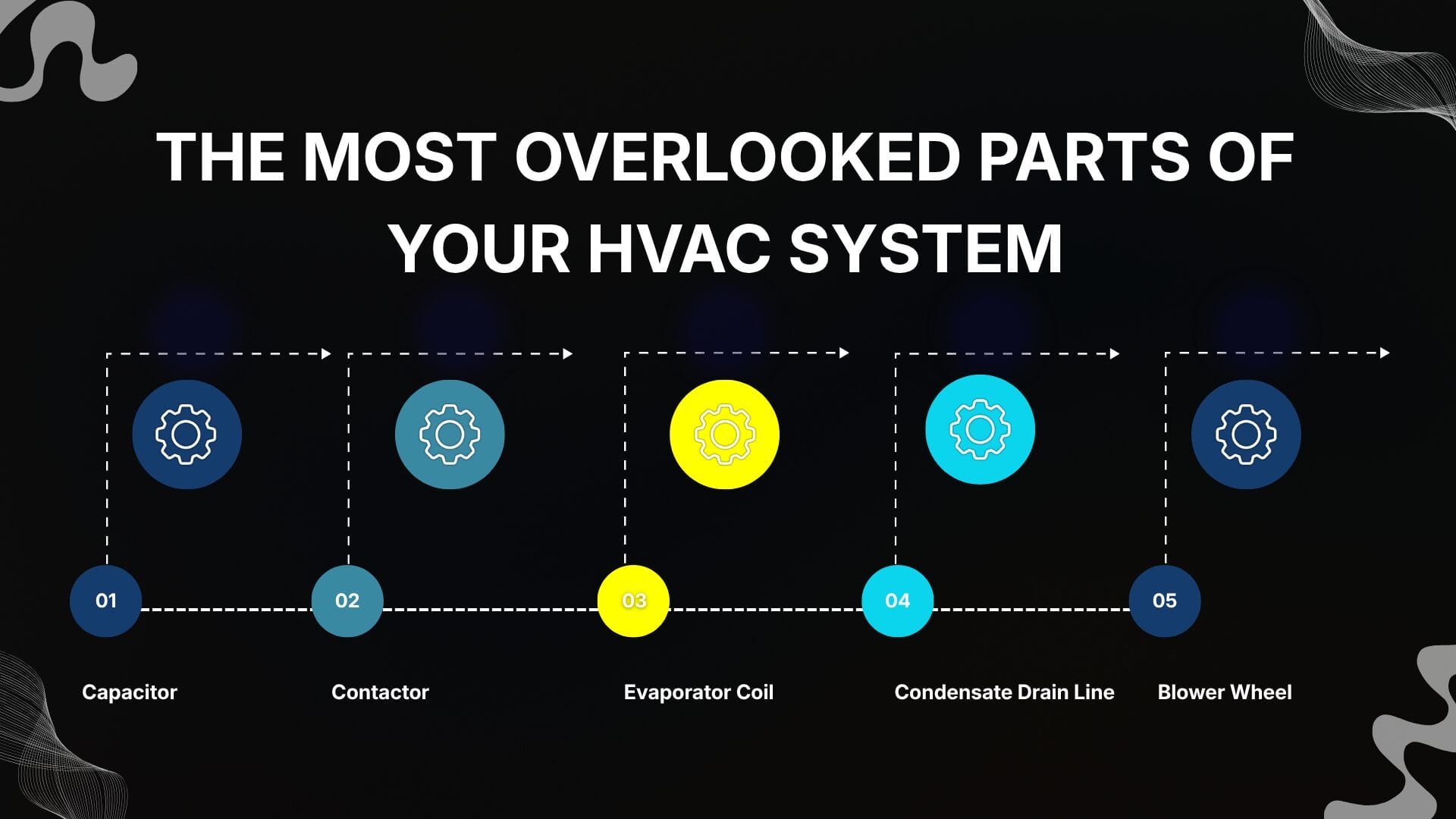
One of the most overlooked components is the capacitor.
Most homeowners have never heard of it, but it’s one of the hardest-working electrical components in your system. Think of the capacitor as the jump-start your HVAC system needs every time it turns on. It stores and releases energy to help power important motors inside your air conditioner, including the compressor and the fan motor.
When a capacitor begins to wear out, your system may struggle to start, cycle on and off unexpectedly, or stop running altogether. It’s a relatively small part, but without it, your air conditioner can’t function properly.
Another component homeowners rarely think about is the contactor.
The contactor acts like a switch that receives signals from your thermostat. When your home needs cooling, the thermostat tells the contactor to send power to your outdoor unit so the cooling cycle can begin.
Because it operates every time your system starts and stops, the contactor experiences regular wear throughout the cooling season. Over time, those electrical contacts can become worn or damaged, affecting how reliably your HVAC system operates.
Then there’s the evaporator coil, one of the most important cooling components in the entire system.
Unlike the outdoor condenser that most people can easily see, the evaporator coil is tucked away inside the air handler. Every bit of warm air inside your home passes over this coil, where heat is removed before cool air is sent back through the ductwork.
Since it’s hidden from view, homeowners rarely think about the evaporator coil. However, keeping it clean and operating properly is essential for maintaining efficient cooling throughout the home.
The condensate drain line is another part that often goes unnoticed.
As your air conditioner cools the air, it also removes moisture. That water has to drain safely away from the system, and that’s exactly what the condensate drain line is designed to do.
If the drain line becomes clogged, water can back up inside the system. Depending on the equipment, this may trigger a safety switch that shuts the air conditioner down to help prevent damage. Homeowners are often surprised to learn that something as simple as a clogged drain line can stop the entire system from operating.
The blower wheel is another component that doesn’t receive much attention, even though it plays a major role in keeping your home comfortable.
Connected to the blower motor inside the air handler, the blower wheel is responsible for moving cooled air through your ductwork and into every room. As it spins, it circulates thousands of cubic feet of air throughout your home each day.
Because it operates behind closed panels, most homeowners never see it. Yet it’s one of the reasons your HVAC system can maintain consistent temperatures throughout the house.
Electrical connections are another example of something homeowners never think about—but HVAC technicians certainly do.
Your air conditioning system depends on numerous electrical connections working together safely and efficiently. Over time, vibration from normal system operation can cause certain connections to loosen or experience wear.
While these issues may not create immediate problems, they’re often checked during professional inspections because catching them early helps prevent larger issues later on.
Even your ductwork deserves more attention than it usually gets.
Many homeowners think of ducts as permanent parts of the house that never require consideration. In reality, ductwork is responsible for delivering every bit of conditioned air throughout the home.
If sections develop leaks, become disconnected, or lose efficiency over time, cooled air may never reach the rooms where it’s needed most. The air conditioner continues working, but some of that cooling is lost before it ever reaches your living spaces.
It’s a good reminder that HVAC performance depends on much more than the equipment itself.
One of the reasons professional HVAC inspections are so valuable is because technicians evaluate these hidden components—not just whether the system is blowing cold air.
A homeowner may only notice that the house feels comfortable, but behind the scenes, dozens of individual parts are working together to make that possible. Identifying a worn capacitor, a partially clogged drain line, or an aging electrical connection before it causes a breakdown can save both time and unexpected repairs.
This is especially important during August, when HVAC systems have often been running for months with very few breaks. By this point in the summer, every component has experienced long hours of operation. Even parts that have performed perfectly all season are under continued demand as temperatures remain high.
Fortunately, modern HVAC systems are built with durability in mind. These components are designed to withstand years of operation, but like any mechanical system, they benefit from regular attention and proper care.
Most homeowners don’t need to know every technical detail about their HVAC system, but having a basic understanding of what’s happening behind the scenes can make a big difference. It helps explain why routine inspections matter, why small changes in performance shouldn’t be ignored, and why an air conditioner is much more than the box sitting outside the house.
At Epic A/C, we believe an informed homeowner is a confident homeowner. We enjoy helping customers understand how their HVAC systems work because knowing the basics makes it easier to recognize when something isn’t operating quite right.
The next time your home feels cool and comfortable on a hot North Florida afternoon, remember that countless components are working together to make that happen. While most of them remain hidden behind panels, walls, and ceilings, they’re all playing an important role in keeping your home comfortable every single day.
That’s why every part matters—even the ones you never see.